for the public understanding of economics and entrepreneurship

Vinson Centre News

News

Bank of England event

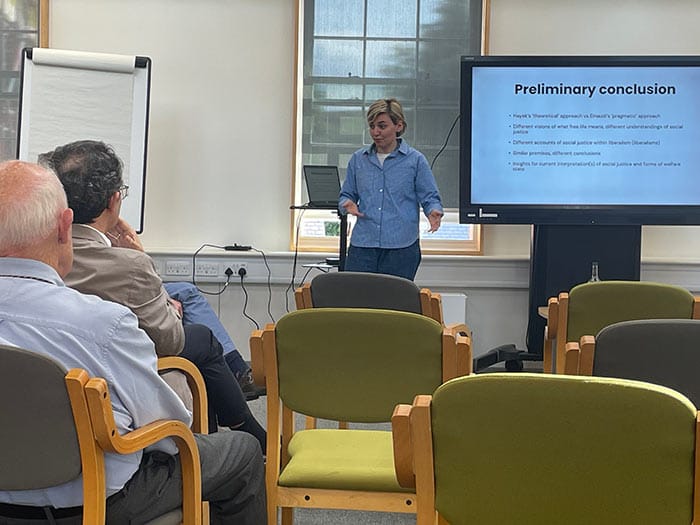
We’re proud to share that Professor Juan Castañeda, Director of the Vinson Centre, was invited to speak and co-organise a recent Bank of England event on “Analysing the Information Content of Money”.

This was an excellent event discussing a topic that the University of Buckingham, Vinson Centre and IIMR have led the research on in the UK, on how to use the information provided by monetary aggregates to assess inflation and changes in the business cycle.

If you’re interested in this topic and would like to find out more about Professor Juan Casteñeda’s Talk “Sectoral Money and Prices”, please follow the link here: Sectoral Money and Prices – Professor Juan Castañeda

Full details about the event are available here: Analysing the information content of money

Study the Ideas Shaping Policy

The research presented at the Bank of England feeds directly into our teaching, and reflects the Vinson Centre’s leading role in monetary economics research in the UK.

At the Vinson Centre, you really do engage with the same ideas that are influencing real-world policy debates.

To find out more about our postgraduate programmes, please see the details on the Vinson Centre Programmes page, or follow the links to their corresponding course pages:

Two new scholarships!

We are delighted to let you know that two new scholarships for the MA Money, Governments and Central Banks (by Research) programme have just been confirmed!

Congdon  Scholarship

Two scholarships of £4,000 are available to students applying to start in September and are designed for students who demonstrate a clear commitment to research in fields that relate to monetary policy.

Criteria and eligibility

To be eligible for this scholarship, candidates need to be looking to conduct research linked to the following topics, amongst others:

  • The relationship between money and inflation
  • Central Bank policies in times of crises
  • The banking system and how it affects macro economic outcomes.

Candidates will also need to have completed a successful interview with the programme director.

Applications for the programme and the scholarships are open now!

Please follow the links below:
Programme: MA Money, Governments and Central Banks (by Research)
Scholarship: Congdon Scholarship

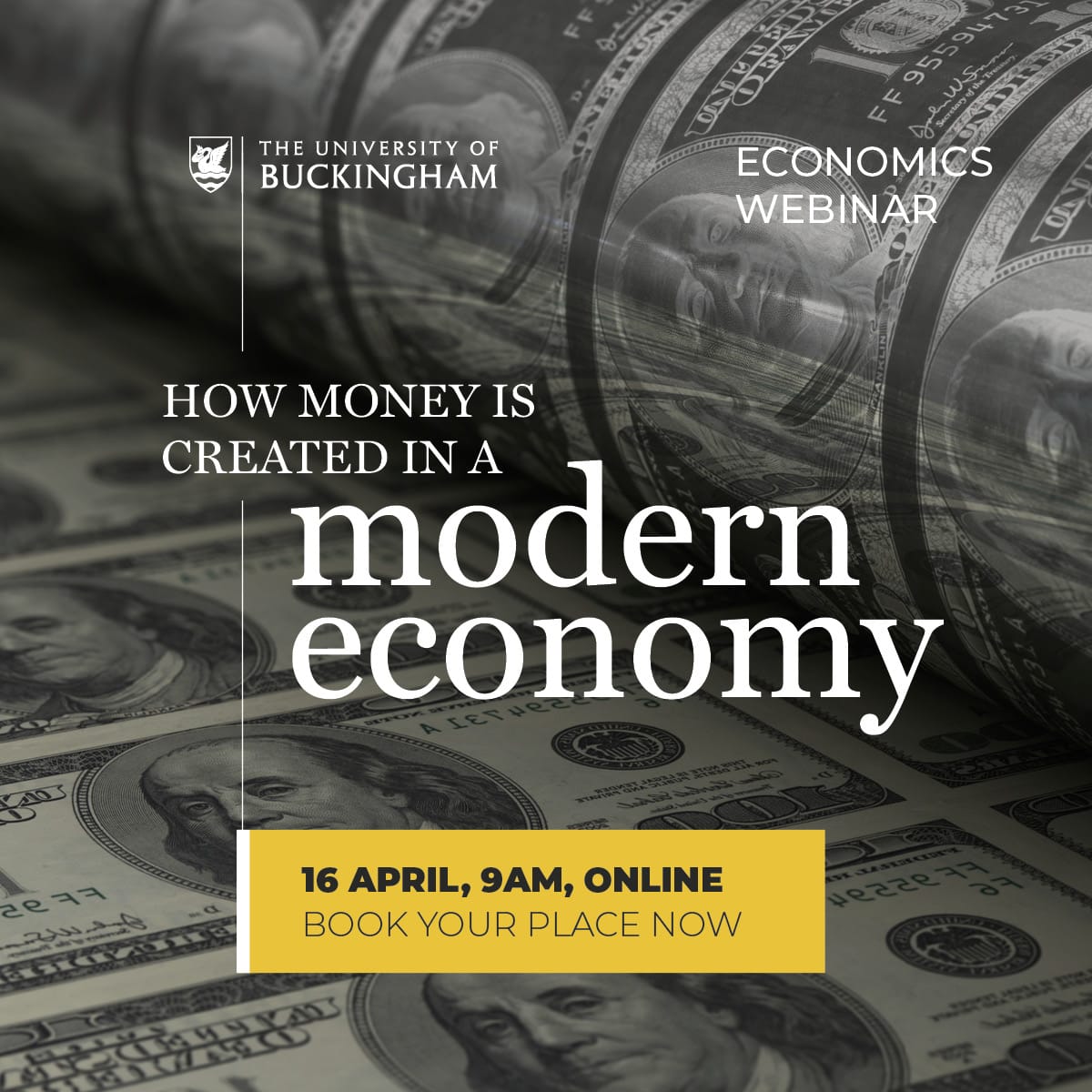
Join us online for a free webinar, ‘How Money is Created in a Modern Economy’ 16 April 2026 9:00BST

Money doesn’t just exist – it’s created, shaped, and controlled in ways that might surprise you.

Join us online on 16 April for an engaging talk led by Professor Juan Castañeda, where you’ll gain a clear and accessible understanding of how money is created in the modern economy. This session will unpack the roles of commercial banks, central banks, and monetary policy, helping you make sense of the forces shaping inflation, financial stability, and economic decision-making today.

This webinar also offers insight into our new Economics programmes: MA Money, Governments and Central Banks (by Research) and Money, Inflation and Monetarism (Short Course). Discover how our courses equip students with the analytical and critical skills needed to navigate complex financial systems and tackle real-world policy challenges with confidence.

Book your free place: How Money is Created in a Modern Economy

Date: 16 April 2026
Time: 9:00-09:45 BST
Venue: Online

New AI Initiative Launched to Rebalance Economic Discourse: The Mainline Economics AI Project

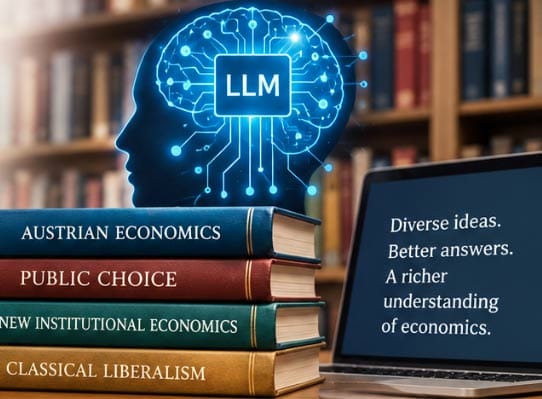
The University of Buckingham has launched The Mainline Economics AI Project, a new initiative aimed at broadening and rebalancing economic discourse. Developed by the Vinson Centre, the School of Computing, and the Institute of Economic Affairs, with support from Summerleaze Ltd, the project uses a fine-tuned Large Language Model (LLM) trained on classical-liberal and heterodox economic literature. Its goal is to provide high-quality, well-sourced answers for academics, journalists, policymakers, and the public—free from the narrow assumptions of mainstream economic models. The AI will draw on insights from traditions such as Austrian, Public Choice, and New Institutional Economics, building a diverse repository of knowledge. Emphasising intellectual pluralism and ideological transparency, the project supports research, teaching, and policy analysis. Leaders involved describe it as a groundbreaking blend of AI innovation and educational mission, designed to restore neglected insights and foster a richer understanding of fundamental economic ideas.

Two new courses offered by the University of Buckingham

MA Money, Governments and Central Banks (by Research)

This research-based online MA programme gives students the knowledge and skills to think critically about practical problems faced by banks, central banks and other financial institutions – essential for anyone hoping to pursue a career in this sector. Co-ordinated by Dr Gabriel Stein and Professor Juan Castaneda, it is particularly relevant given the changes in banking, monetary policy and financial markets since the Global Financial Crisis and Covid-19.

Click here for more information

Money, Inflation and Monetarism (Short course)

The Money, Inflation and Monetarism course is designed for undergraduate students and professionals who wish to explore theories of inflation and macroeconomic stability from a monetarist perspective. You will be introduced to monetary theory, while exploring the roles of banking in a modern economy. Using video material featuring leading monetary economist Professor Tim Congdon, this course offers a unique focus.

Click here for more information

Vinson Centre Seminar Sixth Form Conference 2025 Schedule Announced

Thursday 1 May 2025 st 9:45 AM – 2:00 PM

9:45 AM – 10:00 AM: Refreshments and welcome of schools

10:00 AM – 10:10 AM: Opening by Professor Debarpita Bardhan-Correia (Dean of Faculty of Business, Humanities and Social Sciences, University of Buckingham)

10:10 AM – 11:10 AM: ‘Money and Inflation’ by Dr Juan Castaneda (Director of the Vinson Centre, University of Buckingham)

11:10 AM – 12:10 PM: ‘Business and Entrepreneurship’ by Mr Graham Jones (Senior Lecturer in Business and Management, University of Buckingham)

12:10 PM – 12:40 PM: Lunch Break

12:40 PM – 1:40 PM: ‘The Housing Crisis’ by Dr Kristian Niemietz (Editorial Director, Institute of Economic Affairs)

1:40 PM – 2:00 PM: Presentation by Marketing

Economic Affairs Applied Research Workshop 2024

‘Advancing a Classical Liberal Understanding of the Agenda for a Free Society’

This workshop will offer invited scholars a unique opportunity to engage in meaningful and constructive discussions of working papers to help prepare them for submission to Economic Affairs or other journals. Our aim is to contribute to improving the quality of every paper accepted to the workshop. While we are making an open call for proposals, the Economic Affairs Applied Research Workshop will be a select event open only to invited paper presenters and scholars. An academic committee will review submissions and select up to twenty paper presenters, whose work will comprise the core workshop agenda.

Location: The workshop will be being held at Universidad Francisco Marroquín in Madrid: Calle de Arturo Soria, 245, 28033 Madrid, Spain.

Date: December 13-14, 2024.

Deadline for submission of proposals (abstract): 31 July 2024.

Web page with more information: https://economicaffairsworkshop.ufm.edu/

For further information, contact Juan Castaneda at juan.castaneda@buckingham.ac.uk

About Economic Affairs

Economic Affairs is a peer reviewed journal published by the Vinson Centre at the University of Buckingham and the Institute of Economic Affairs, in collaboration with Universidad de las Hespérides and Universidad Francisco Marroquín, through academic publisher Wiley. It is edited by Professor Len Shackleton.

The journal is indexed by Scopus and is part of the Emerging Sources Citation Index (ESCI). It has published a wide range of authors from around the world, including a number of Nobel Prize laureates, while focusing on non-mathematical approaches to economic analysis.

For more than forty years, the journal has published original work and commentaries by hundreds of authors broadly sharing our approach to classical liberal political economy. Nowadays, in contrast with some of our other output, it has a particularly strong international focus. Three-quarters of our readership is based overseas, as is a large proportion of our authors. This was not the case when Economic Affairs was first launched by Arthur Seldon and the IEA back in 1980.

The journal is published three times per year, in February, May, and October. Here you can access the latest issues.

The journal publishes main articles (around 7,000 words in length), as well as short articles, of no more than 3,500 words, reporting on larger studies which may be published in full elsewhere. The journal also has a book review section.